Bernina Express from Milan: Is It Worth It? Read This Before You Waste Time and Money
|
Written by Oleg Danylyuk Licensed tour guide in Milan. I have done hundreds of Bernina days of every kind: coaches of 60 people, and couples of two with first class on the Bernina Express and lunch in a Michelin-starred restaurant in St. Moritz. I have seen St. Moritz in every season, from +25°C (77°F) in July to −25°C (−13°F) in January. Full disclosure: I co-founded Abroads Tours, which sells one of the options compared below (the private tour). Everything else in this guide applies whoever you travel with. Last updated: 20 November 2026 |
I have heard people call their Bernina day the best day of their whole holiday. I have heard others call it 13 hours, mostly on the road, watching the Alps over strangers' phones. Same mountains. Same glaciers.
I have done hundreds of these days, in 60-seat coaches and in private first class. The difference is never the railway. It is four things you decide before you book: which train you are actually on, whether a window seat is really yours, which day you go, and how much time you really get in St. Moritz.
Below is all of it, in the order it usually goes wrong, with what to do about each. Read it before you book anything, ours included.
|
Short on time? The 8 things to know in 30 seconds 1. The Bernina Express train does not leave from Milan. On the day-trip route it runs between Tirano (Italy) and St. Moritz (Switzerland). Milan to Tirano is about 160 km by road. 2. It is a 12–13 hour day. About 6 – 6½ hours of it is on the road, and about 2¼–2½ hours on the famous train. 3. Big coach tours don't put you on the Bernina Express panoramic cars. They use the regular Bernina trains, often the older carriages. 4. On big group tours seats are not assigned. Whoever gets into the carriage first gets the window. 5. Avoid Sundays. Lake and ski traffic can add up to 3 hours to the day. 6. Lunch or St. Moritz. On most day trips there is time for one of the two, done properly, not both. 7. Bring a passport or EU ID card and dress for St. Moritz, not for Milan: it sits at 1,822 m (5,978 ft) and is usually about 10°C (18°F) colder. 8. Done well, it is a once-in-a-lifetime day: from palm trees to glaciers in about an hour, on a UNESCO World Heritage railway. |
|
The route of a typical day trip 🏙️ Milan → 🚐 road, ~160 km, 2½–3 h → 🌴 Tirano (429 m) 🌴 Tirano → 🚆 Bernina train, 61 km, 2¼–2½ h, up to 2,253 m → 🏔️ St. Moritz (1,822 m) 🏔️ St. Moritz → 🚐 road over the Maloja Pass, ~180 km, 2¾–3½ h → 🏙️ Milan |
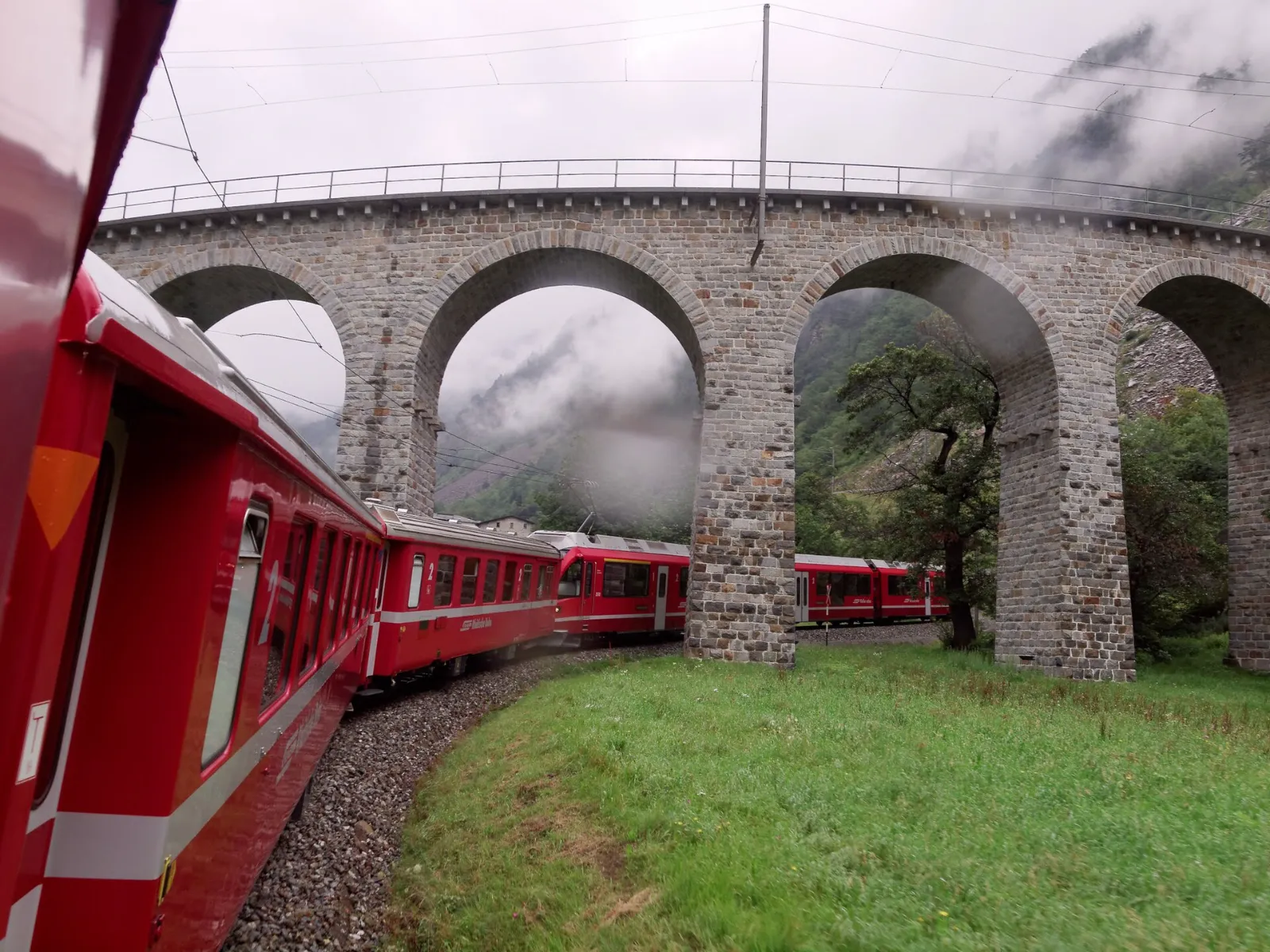
The Brusio spiral viaduct (1908): the train loops around to gain height. Photo: Maxombrini, CC BY-SA 4.0, via Wikimedia Commons.
Can you take the Bernina Express from Milan?
No, the train never comes to Milan. The Bernina line of the Rhaetian Railway (RhB) is 61 km of mountain railway between Tirano, a small town in the Valtellina valley in Italy, and St. Moritz in Switzerland. Albula line services continue to Chur, further north, but Milan is not on the line. To ride it from Milan you first travel to Tirano or St. Moritz, by road or by regional train. Nobody can move St. Moritz closer to Milan.
This is how an organised day usually looks. Times are typical, not guaranteed:
| Leg | Distance | Private van | 55 seat coach |
| Milan → Tirano (road) | ~160 km | ~2h30 | ~3h, incl. a ~30-minute stop |
| Tirano → St. Moritz (Bernina train) | 61 km | ~2h15–2h30 | ~2h15–2h30 |
| St. Moritz → Milan (road, Maloja Pass) | ~180 km | ~2h45–3h | ~3h30, incl. a ~30-minute stop |
| Total time on the road | ~5h15–5h30 | ~6h30 |
Some tours run it the other way round: road to St. Moritz first, the Bernina train down to Tirano, and road back to Milan from Tirano. Same hours, different order. The coaches I used to work on years ago stop for about 30 minutes in each direction, which adds roughly an hour compared with a private vehicle.
The 160 km to Tirano look short on a map. Most of it is lake road and valley road (the SS36 along Lake Como and the SS38 through the Valtellina), not motorway, with low speed limits and many speed cameras. It feels long in a seat.
And that is before the biggest surprise of the day: which train you are actually on.
Bernina Express vs the regular red train: which one will you actually be on?
This is the most misunderstood part of the whole trip. "Bernina" is the name of the railway line, not of one train. Several kinds of trains run on exactly the same track, over the same viaducts, past the same glaciers, in roughly the same time. What changes is the carriage you sit in, and whether your seat is reserved.
| Train | Windows | How often (Tirano–St. Moritz) | Good to know |
| Bernina Express, 1st class | Big panoramic windows into the roof; they don't open | About 1 a day each way in winter, 2 in summer | Wide seats, 2+1. Few seats, sells out first. Paid seat reservation compulsory. |
| Bernina Express, 2nd class | Same panoramic windows | Same departures | Seats 2+2. Reservation about CHF 32 per person each way on top of the ticket (2026 planning figure). |
| Regular train, modern Stadler "Allegra" units | Large side windows | Regular services, roughly hourly | Modern, comfortable, plenty of space. Same line, same stops, same scenery, far more availability. |
| Regular train, older red carriages | Smaller windows that open | On regular services | Older seats, less space. This is where large groups are usually seated. |
Departures and fees change by season: check the Rhaetian Railway's Bernina Express page for your date.
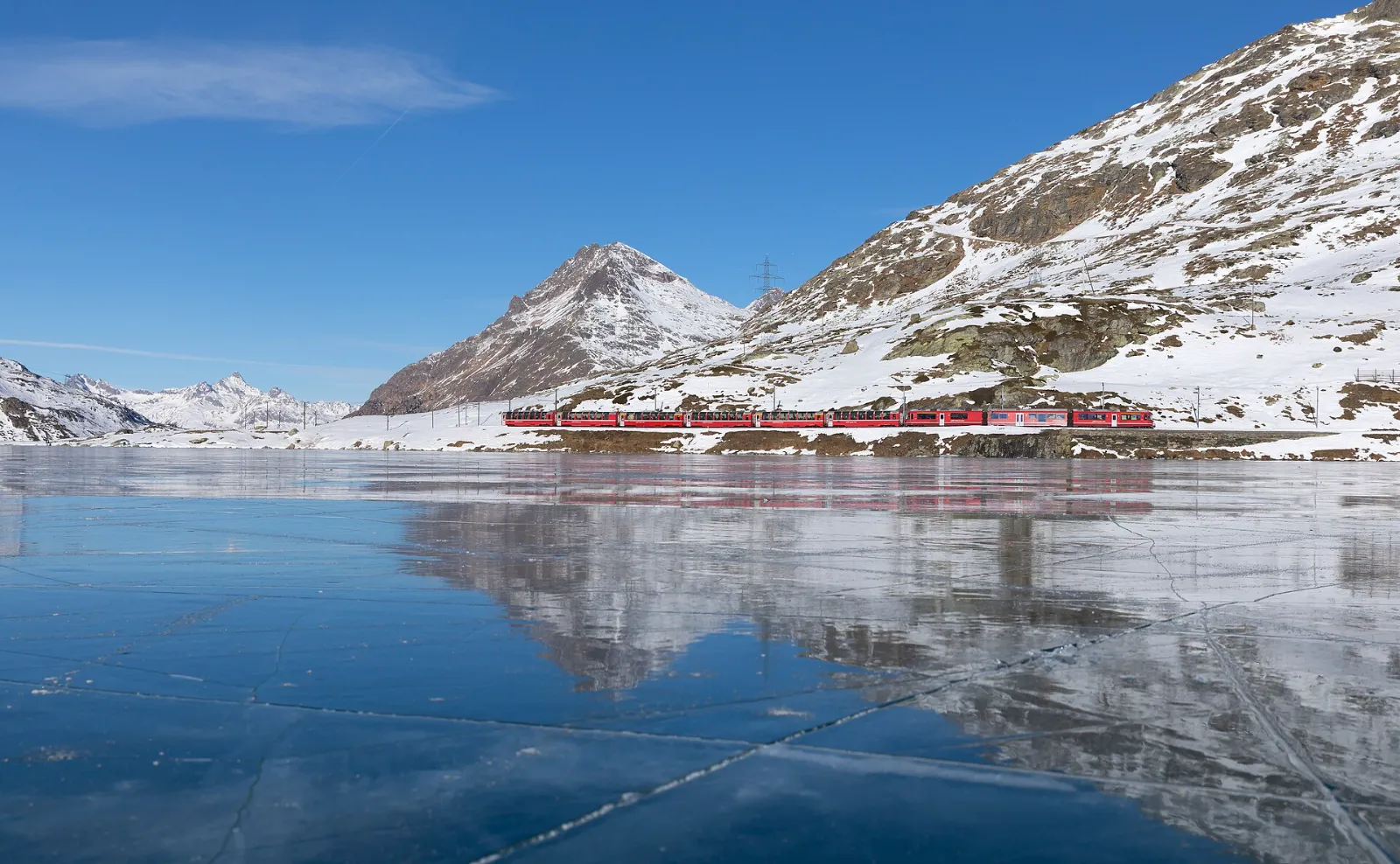
Bernina Express panoramic carriages at Lago Bianco, near the top of the line. Photo: Kabelleger / David Gubler, CC BY-SA 4.0, via Wikimedia Commons.
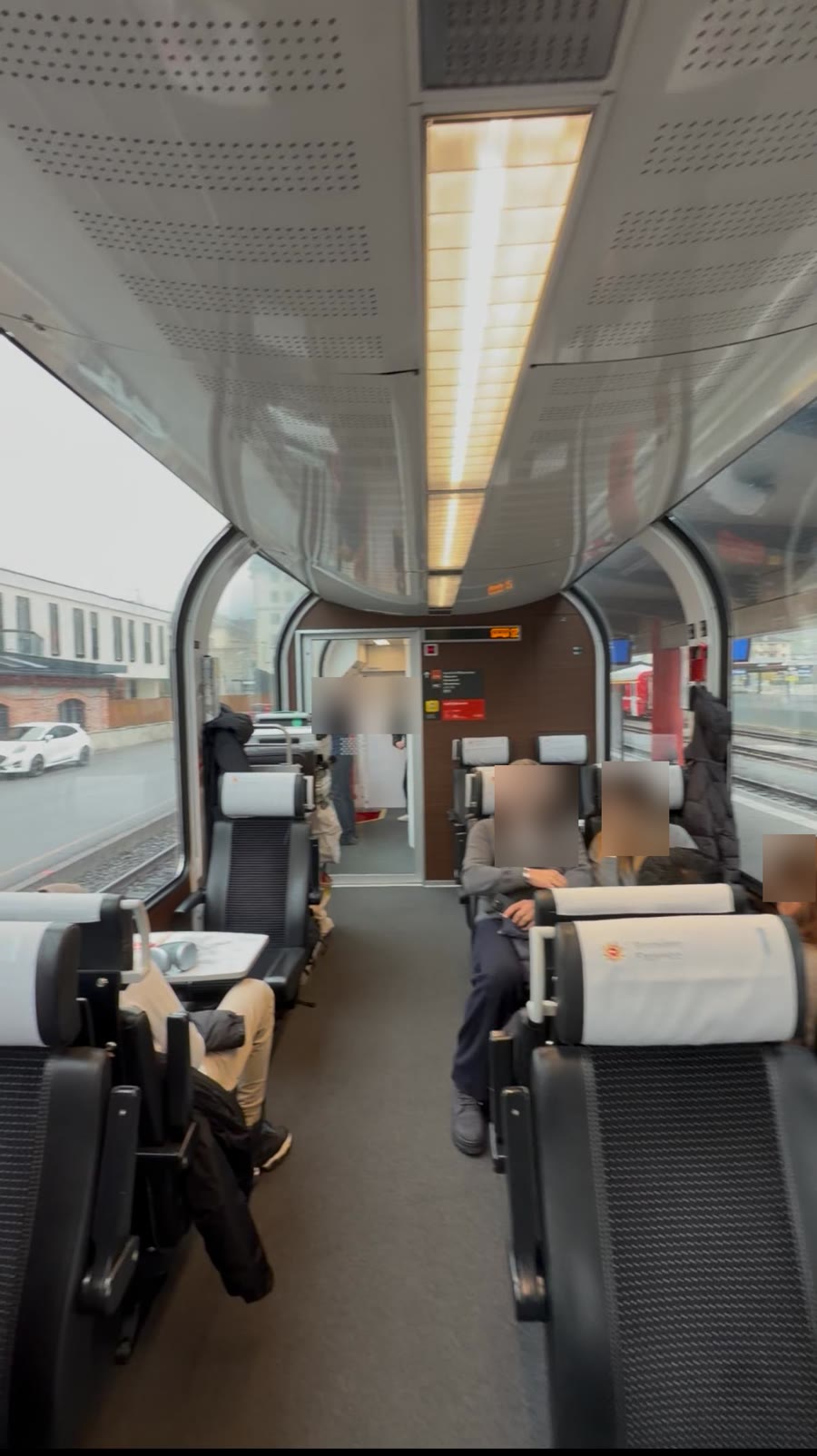
First class on the Bernina Express: 2+1 seats and windows reaching into the roof. Photo: Oleg Danylyuk (faces blurred).
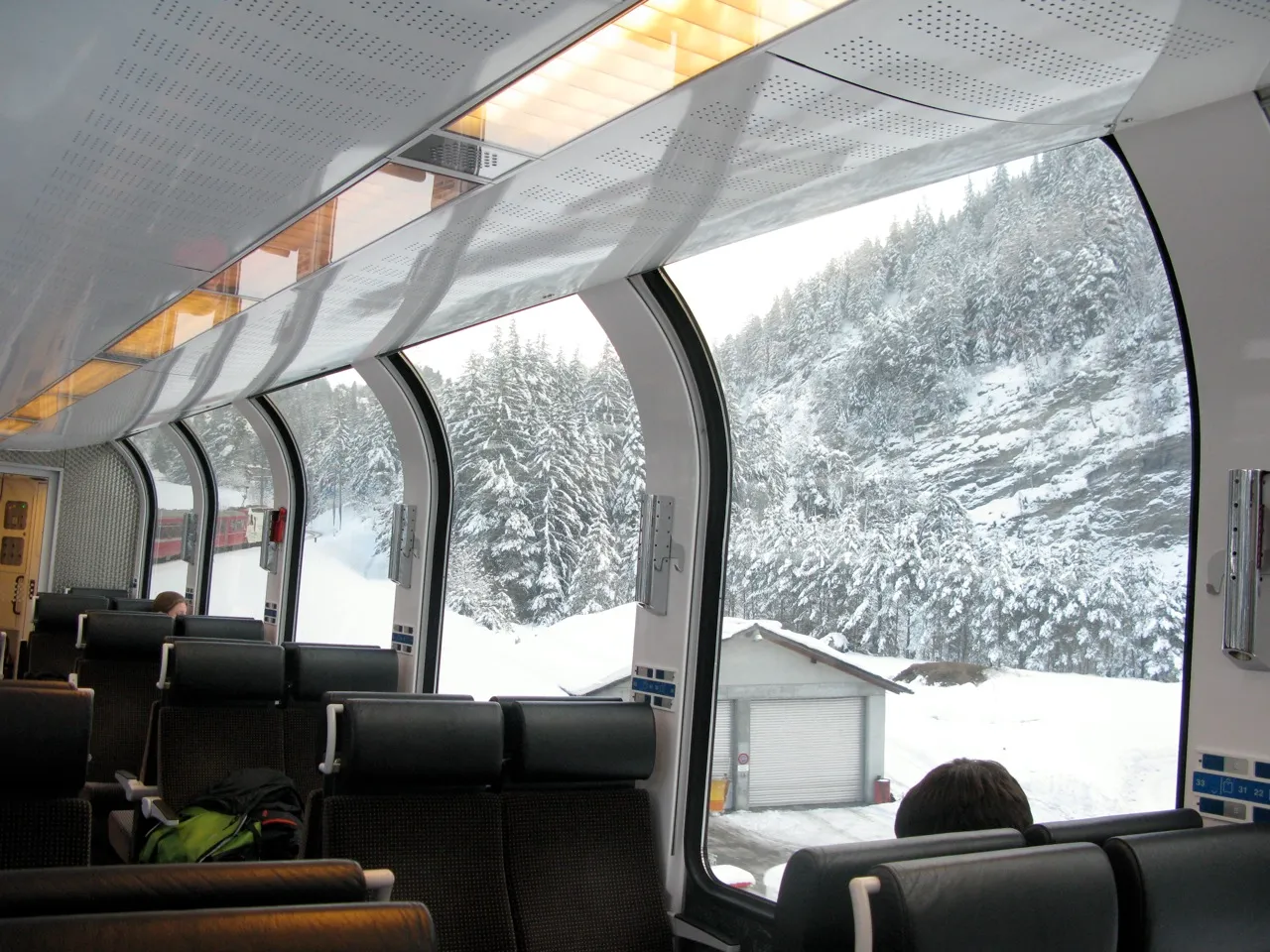
Inside a Bernina Express panoramic carriage in winter. Photo: dirt, CC BY 2.0, via Wikimedia Commons.
Why big coach tours don't use the Bernina Express. It isn't bad will, it's logistics. From Milan there is in practice one usable Bernina Express departure a day in each direction: the morning one leaves Tirano too early to reach by road. Its panoramic seats sell out months ahead, and nobody holds 55 of them for a coach. So large groups book whole carriages on the regular trains, usually the older ones, because those have the availability. Agencies have to reserve these blocks of seats far in advance, and they are hard to change afterwards.
That is not a scandal, and the regular train is genuinely beautiful. But if a tour is sold as "Bernina Express" and you expect the panoramic carriages from the photos, you will feel cheated. Before you book, ask: "Which train exactly, which class, and are seats assigned/reserved?"
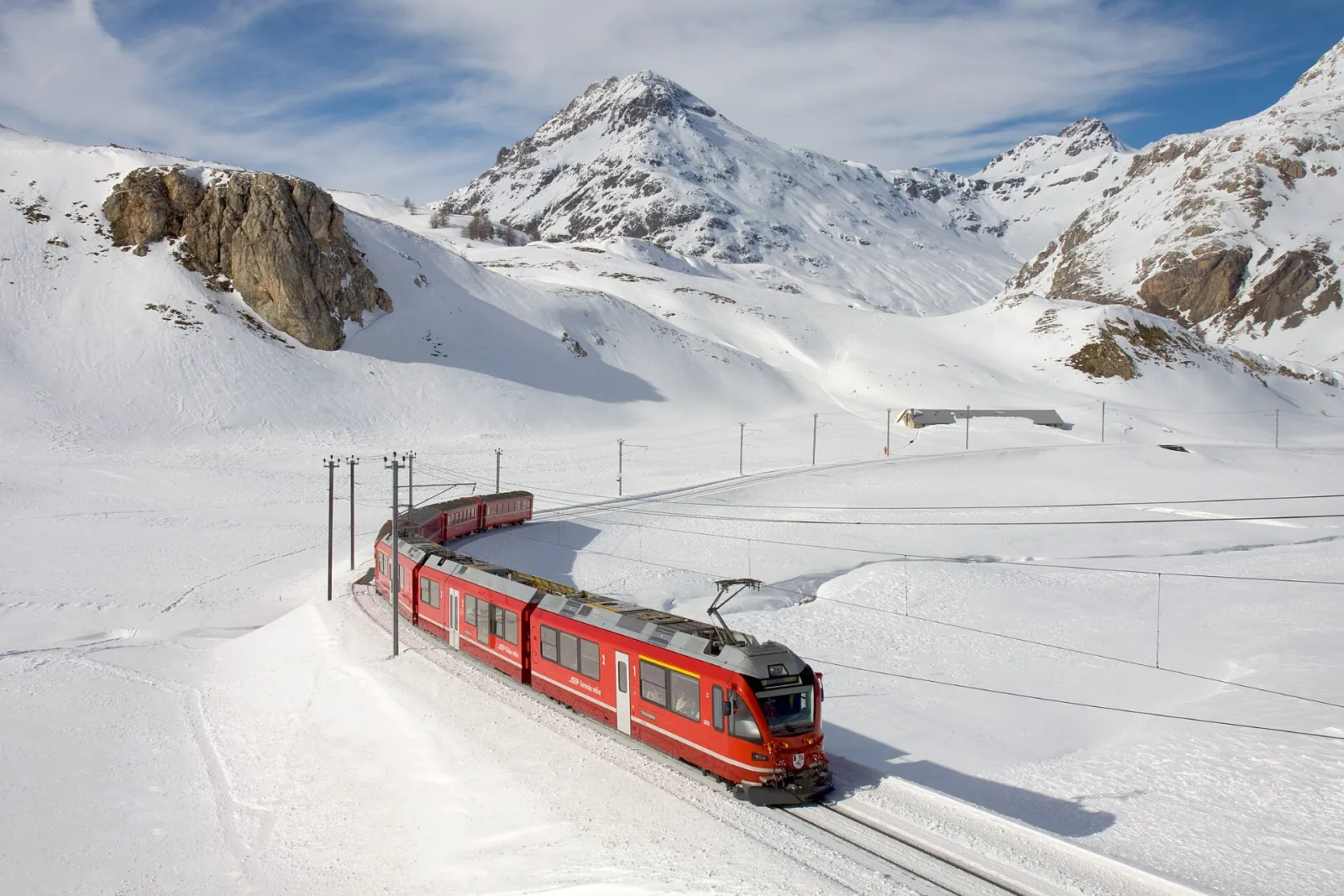
A modern Stadler Allegra train, used on regular Bernina services, near Ospizio Bernina. Photo: Kabelleger / David Gubler, CC BY-SA 3.0, via Wikimedia Commons.
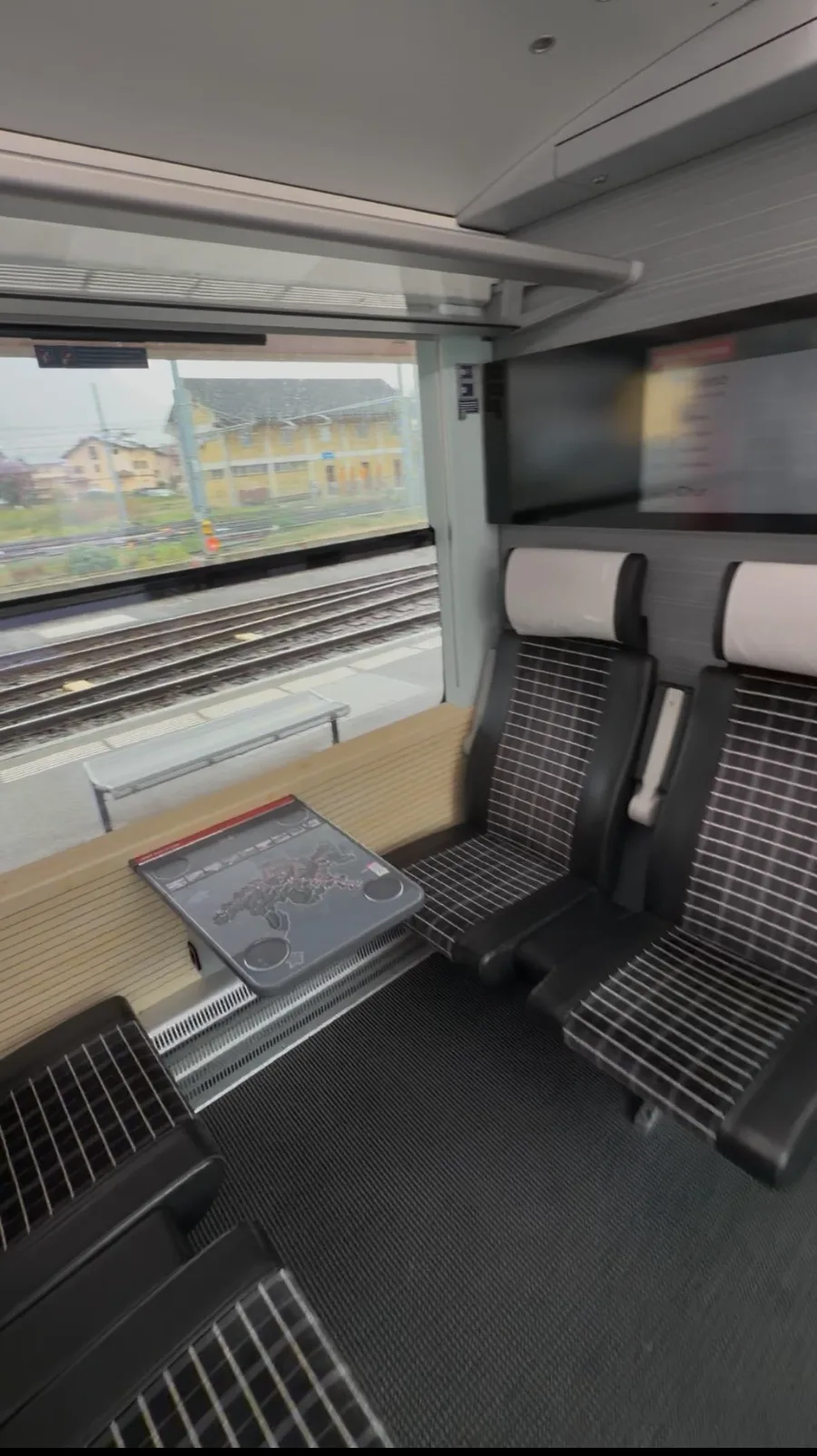
First class on a regular Bernina train: big windows, a table and plenty of space. Photo: Oleg Danylyuk.
The good news about the regular train. The modern Allegra trains are the closest thing to the Bernina Express without the reservation stress: new, spacious, with big windows, and they run roughly every hour, so there is much more availability. The scenery is exactly the same, because the track is the same.
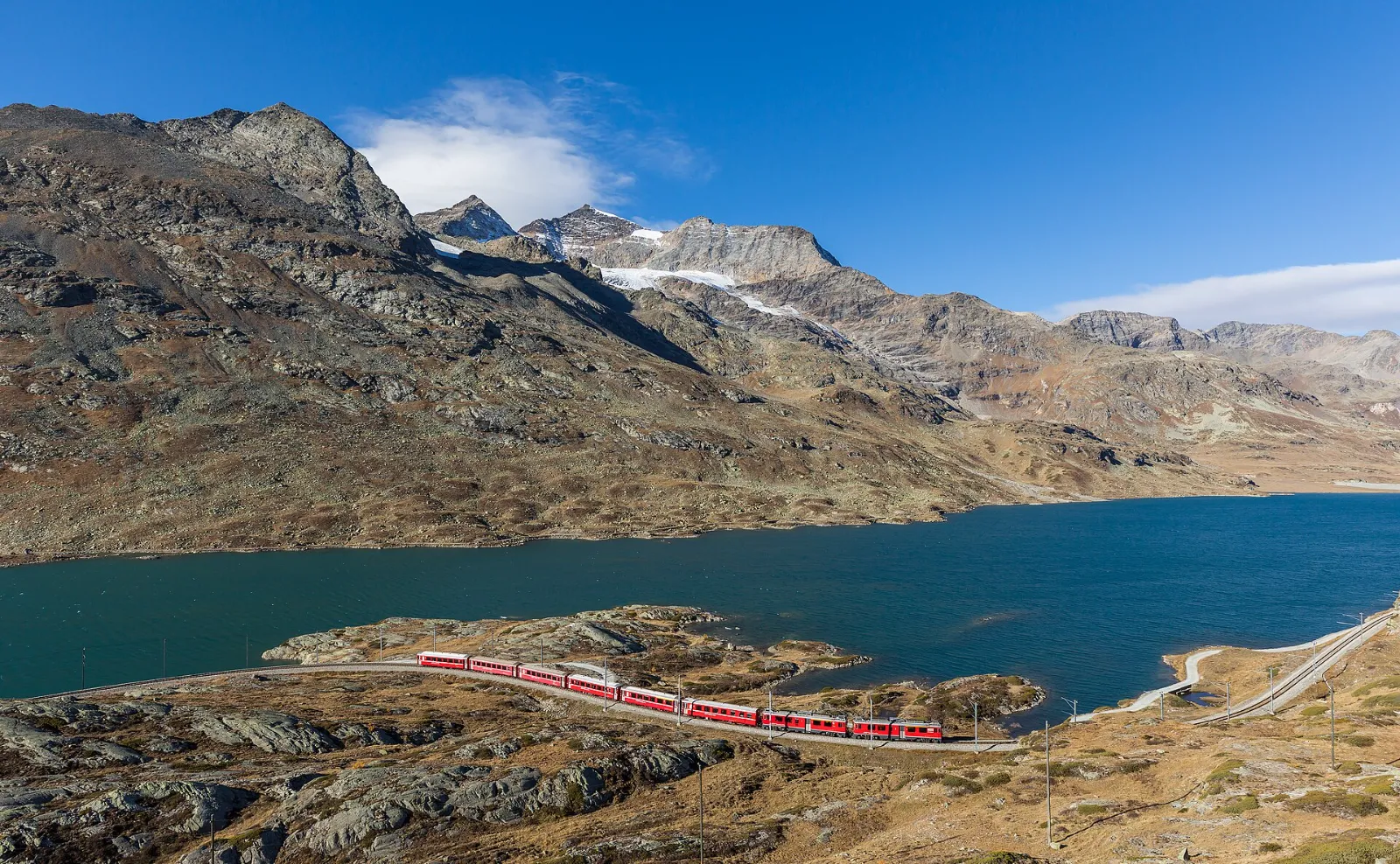
A regular Bernina local train at Lago Bianco. Photo: Kabelleger / David Gubler, CC BY-SA 4.0, via Wikimedia Commons.
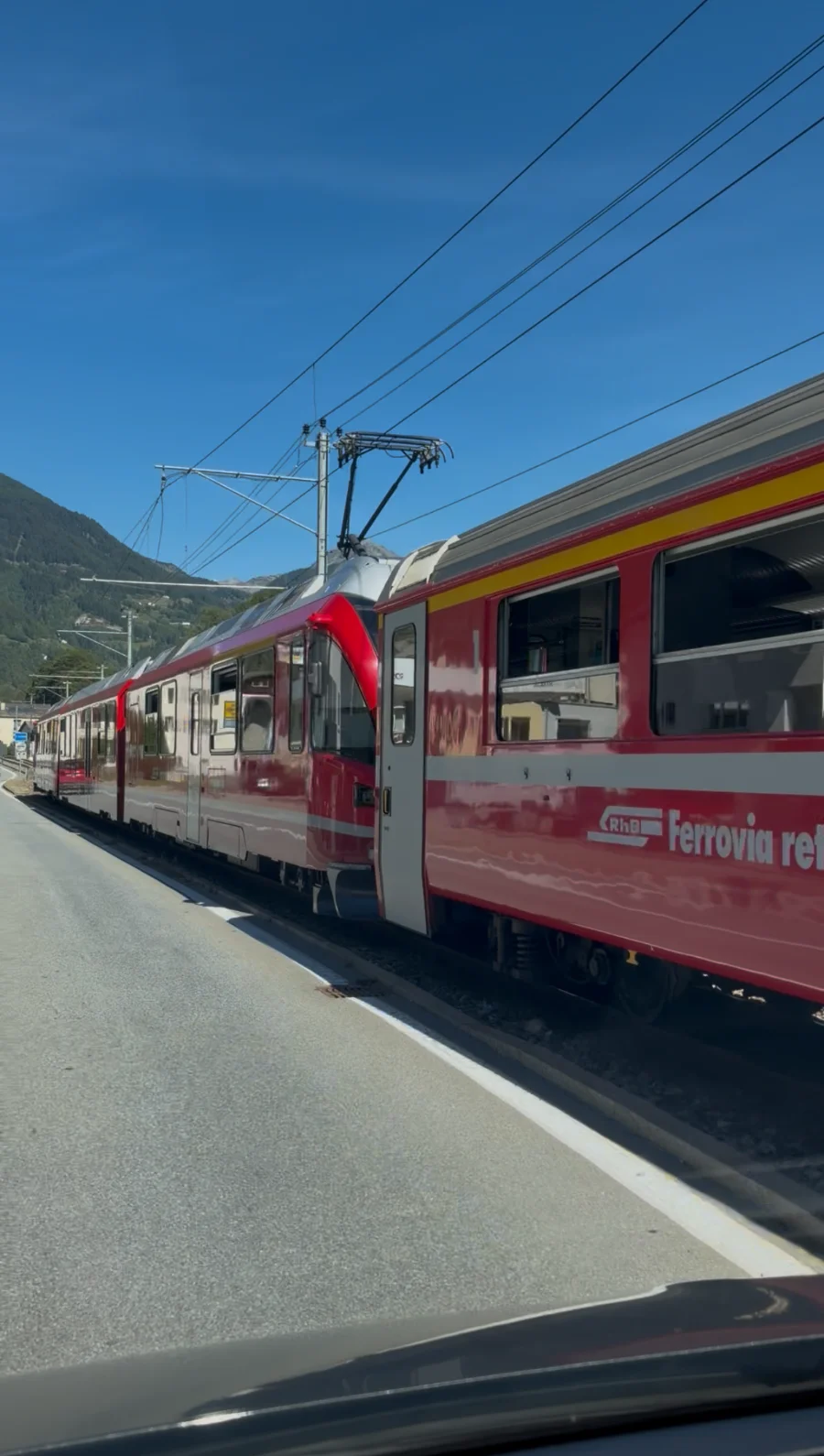
The same train, two kinds of carriage: a modern one in front, an older one with windows you can open behind. Photo: Oleg Danylyuk.
Even on the right train, one thing decides whether you see the Alps or the back of someone's head: your seat.
The window seat trap (and which side to sit on)
In my experience, a standard Bernina carriage holds around 48 people, while a full tour coach brings up to 55—so a full bus fills an entire carriage. And in groups that size, individual seats are never assigned. Some travelers' reviews jokingly call it the "Sardine Express." That's an exaggeration, though not by much on a busy day.
- First in, window seat. Whoever gets through the door first takes the windows. Families end up split, couples sit with strangers.
- Everyone stands up for photos. The landscape never stops, so people stand, lean and open the windows. You get cold air in your face and somebody's back in your view.
- Aisle seat, lost view. On the aisle, you can spend two and a half hours looking at other people's phones.
If you go with a big group: be among the first in line when the group walks to the train. And give your tour guide a tip of €10–20 early in the day. A good guide will share all the "secret" information, from where to stand on the platform to where to eat. Little money, big difference.
Which side should you sit on? People ask me this more than anything else. The honest answer: there is no single "right side". On the way up from Tirano the best views switch sides several times, through the Brusio spiral, along Lake Poschiavo and at Lago Bianco. A window seat on either side beats an aisle seat on the "right" one. Travelling as a couple? Take the two window seats facing each other instead of two seats side by side: you each get a window.
|
How we handle it: on our private day we book first-class seats at the window in advance, so nobody in your group fights for a view. See the private Bernina tour. |
The worst day to go, and when St. Moritz is closed
Avoid Sundays. The road from Milan to Tirano runs along Lake Como, and for long stretches there is no alternative route.
- In summer, half of Milan drives to the lake on Sunday morning and back on Sunday evening: your direction, your hours.
- In winter, the same road takes the skiers north in the morning and back in the evening.
- On top of that, many Italians ride the Bernina train on Sundays, so stations, carriages and restaurants are crowded.
On a Sunday the queues can add up to 3 hours to an already 12-hour day. On a group tour, an hour lost in traffic in the morning is an hour taken from St. Moritz: the group is booked on one specific train, and 55 people cannot simply take the next one.
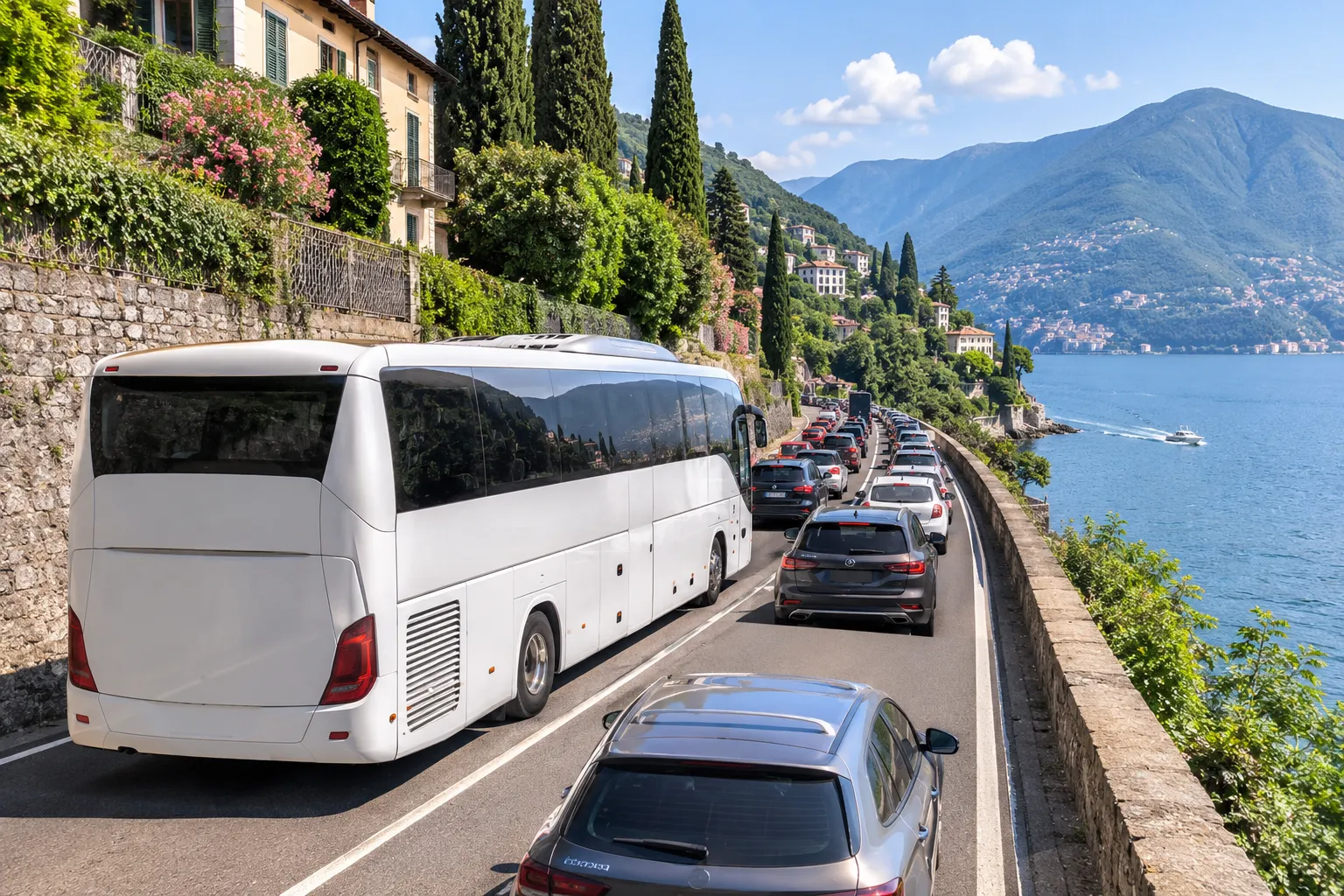
Sunday traffic on the lake road from Tirano. Illustration
Check the season in St. Moritz before you book. The town runs on two main seasons—winter and summer. In between them, especially in early November, most hotels, shops, and restaurants shut down, turning St. Moritz into a bit of a ghost town. A big bus group can't adapt the itinerary around that; a private day can—whether that means spending more time on the train line, having a longer lunch in Tirano, or making a stop elsewhere
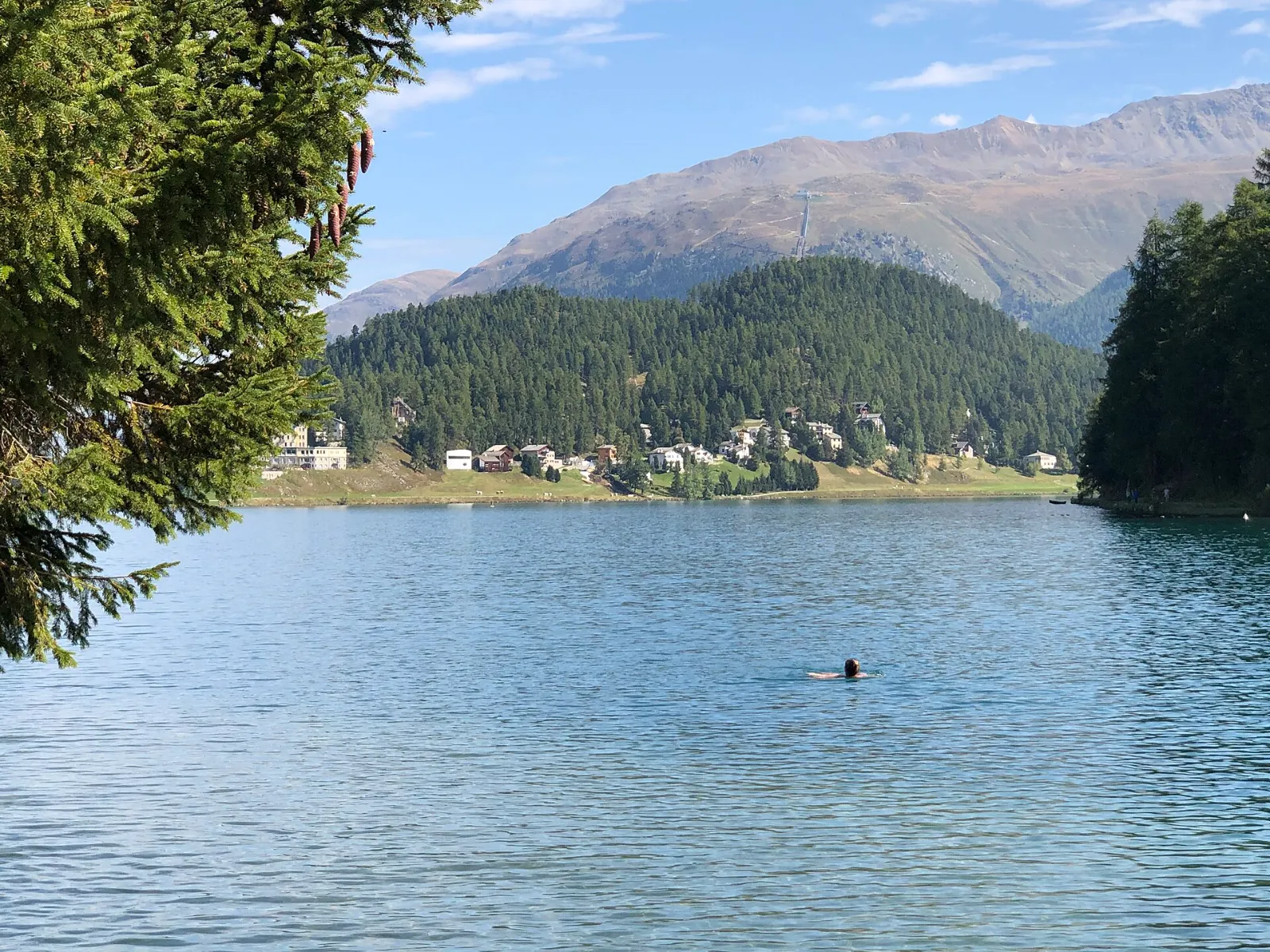
Lake St. Moritz in summer. Photo: Rocketqueenvonmehrental, CC BY-SA 4.0, via Wikimedia Commons.
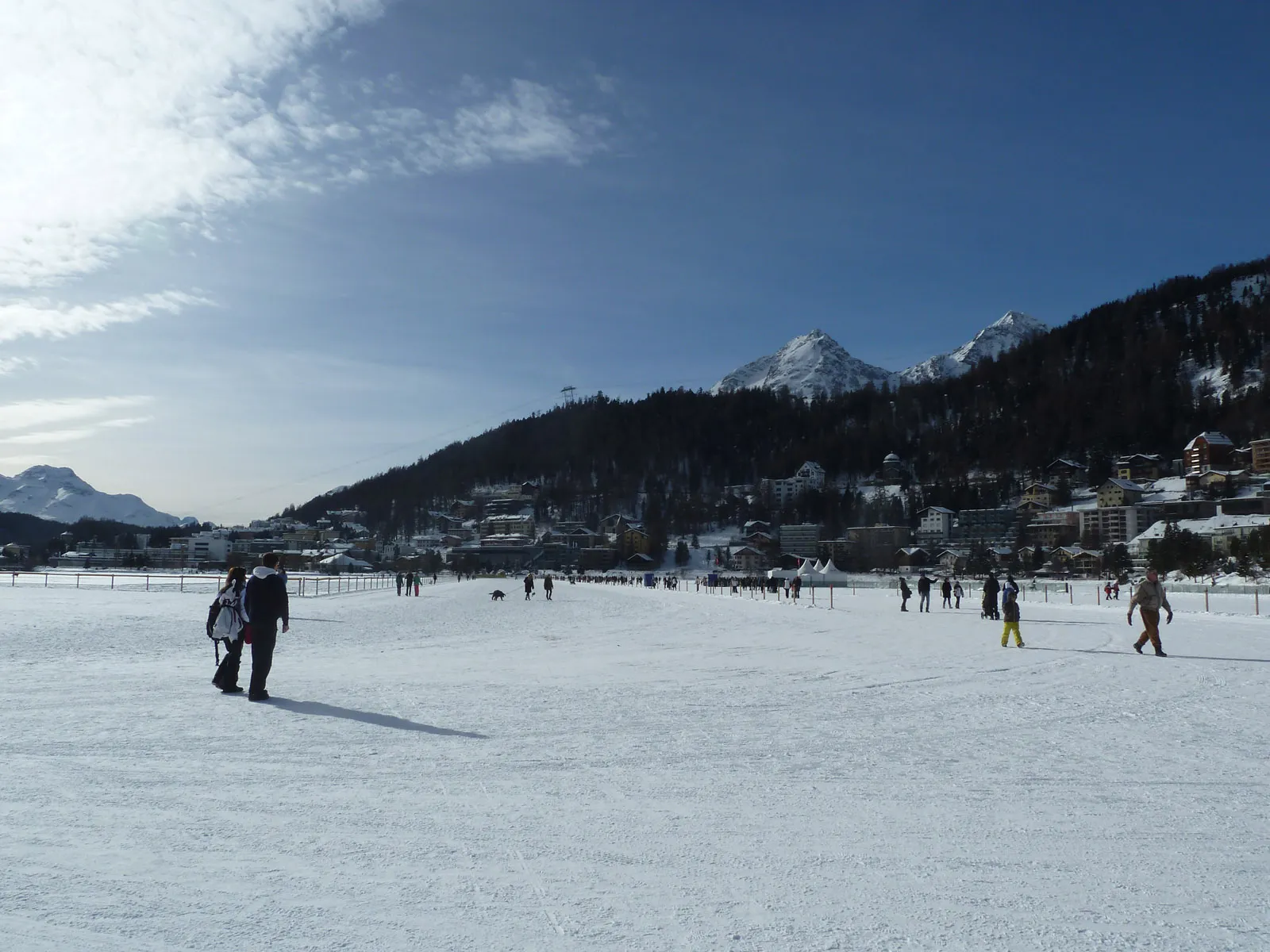
St. Moritz from the frozen lake in winter. Photo: Etiaetia1020, CC BY-SA 3.0, via Wikimedia Commons.
Check the weather for St. Moritz, not for Milan. St. Moritz is at 1,822 m (5,978 ft) and the line crosses the Alps at 2,253 m (7,392 ft). It is usually around 10°C (18°F) colder than Milan, often more. I have stood there at +25°C (77°F) in July and at −25°C (−13°F) in January. Dress in layers.
|
How we handle it: on a private day we choose the date and the direction with you, move the pickup earlier when traffic is expected, and adapt the stops to the season. |
Lunch or St. Moritz? The time trap nobody mentions
On a day trip from Milan, the time in St. Moritz is short. You get to choose: either you have lunch, or you see St. Moritz properly. Or you have lunch, buy some Swiss chocolate, and it's already time to go. There is rarely time for all three.
About restaurant tips: a guide working with 55 people on a tight schedule will usually point you to the fastest option that suits most of the group—often pizza, pasta, or lasagne near the station, or a place the tour has an arrangement with. To be honest, I used to do the same many years ago — it is almost the "industry standard." Understandable, but eating pizza in the Alps is, for me, a crime.
Eat what the mountains make: pizzoccheri (buckwheat pasta with potatoes, cabbage and melted cheese) and bresaola in the Valtellina, fondue and Rosti in the Swiss Engadine. If lunch matters to you, plan and book it before the day, in Tirano or in St. Moritz.
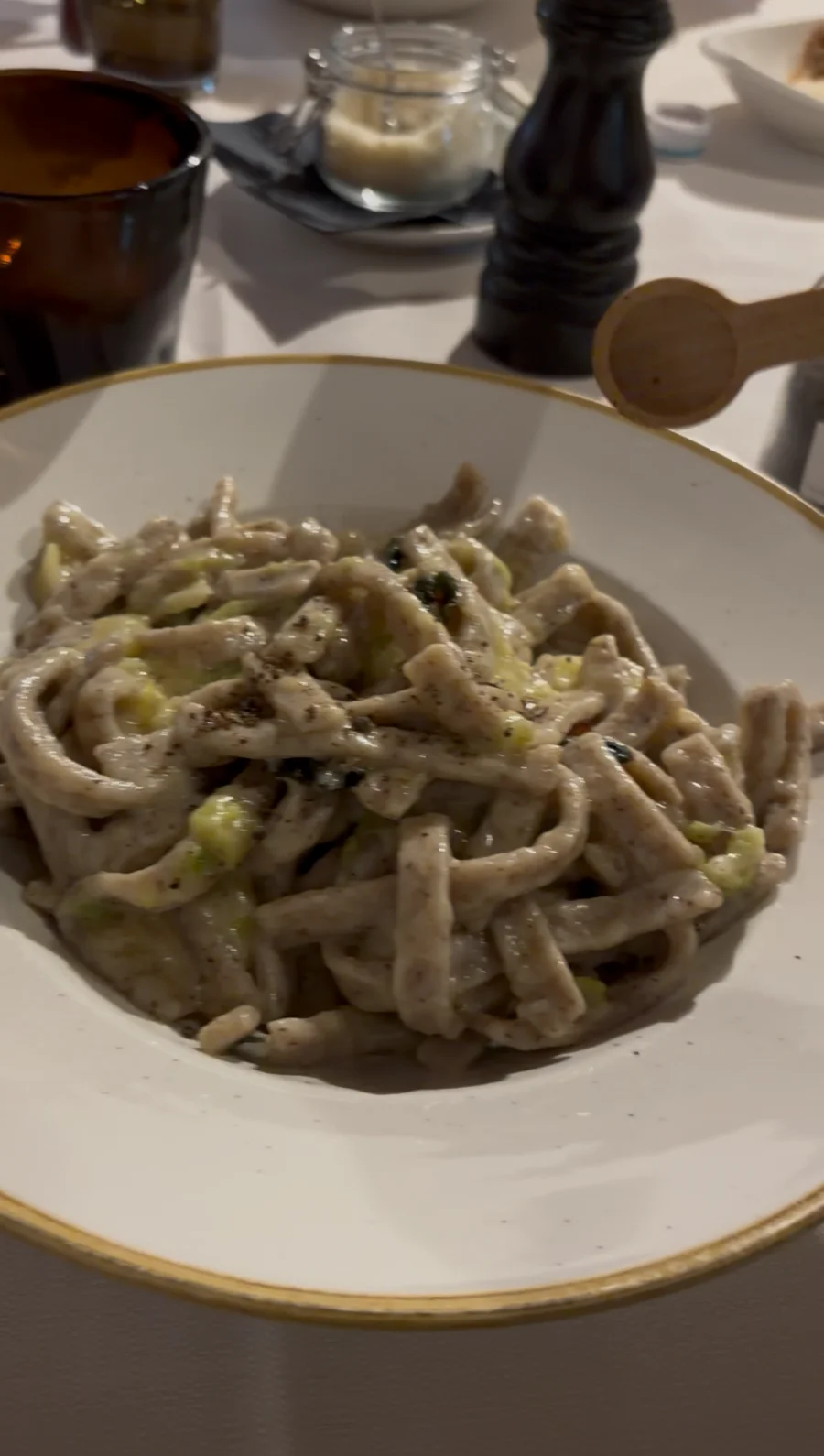
Pizzoccheri: buckwheat pasta, potatoes, cabbage and plenty of melted cheese. Photo: Oleg Danylyuk.
What you see: from palm trees to glaciers in about an hour
When it's done well, this is one of the most spectacular train rides in the world. The Bernina line opened throughout in 1910, has been part of the UNESCO World Heritage site "Rhaetian Railway in the Albula / Bernina Landscapes" since 2008, and climbs on gradients of up to 7% without any cogwheel. At 2,253 m it is the highest railway crossing of the Alps.
- Tirano (429 m / 1,407 ft): the train runs through the town and its main square, past the Madonna di Tirano basilica, among palm trees and vineyards.
- Brusio spiral viaduct: a circular stone viaduct from 1908 where the train loops around to gain height.
- Lake Poschiavo and the Valposchiavo: Italian-speaking Switzerland, villages and chestnut woods.
- Alp Grüm: the balcony facing the Palü glacier, with the valley far below.
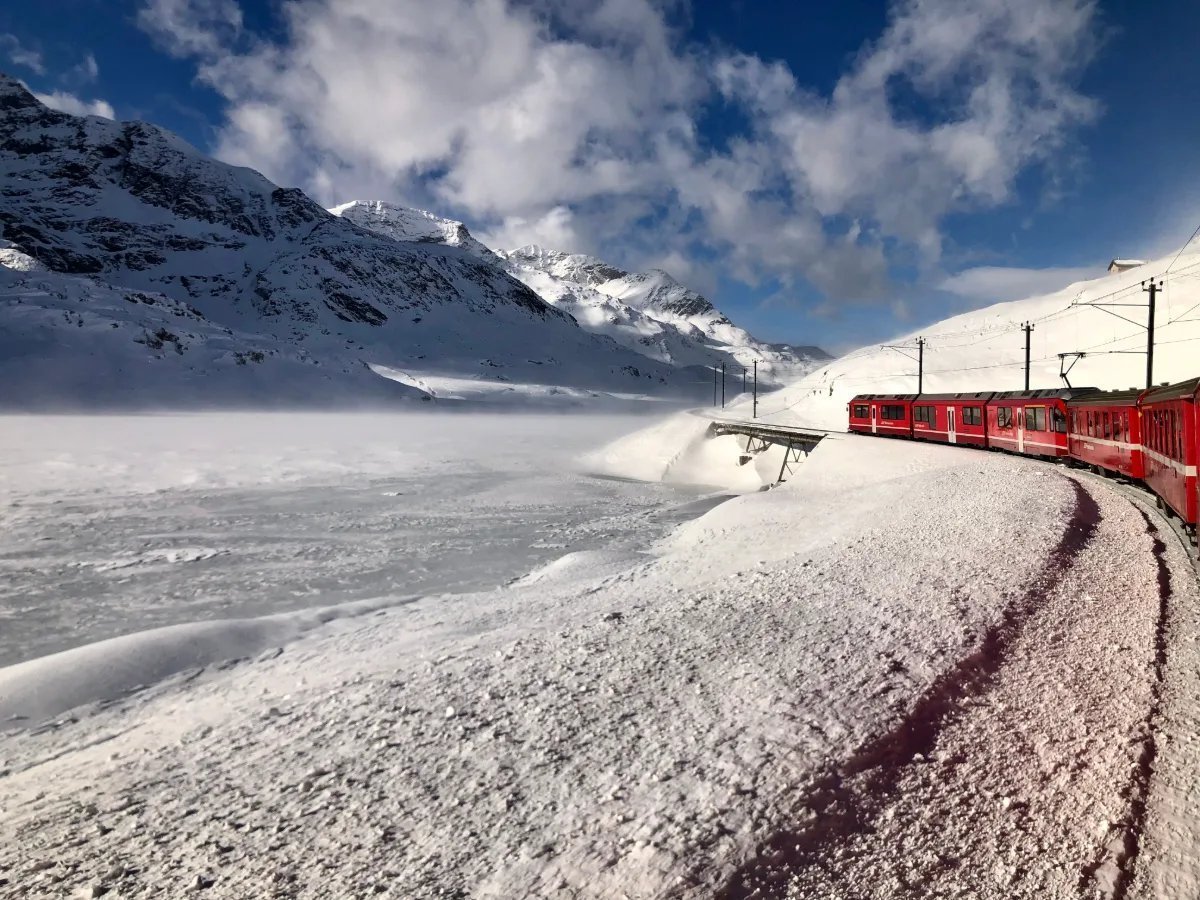
- Ospizio Bernina (2,253 m / 7,392 ft) and Lago Bianco: the top of the line, a pale glacial lake, often with snow until early summer.
- Morteratsch glacier and Piz Palü: big glacier views, weather permitting.
- Pontresina and St. Moritz: the Engadine valley and its lakes.
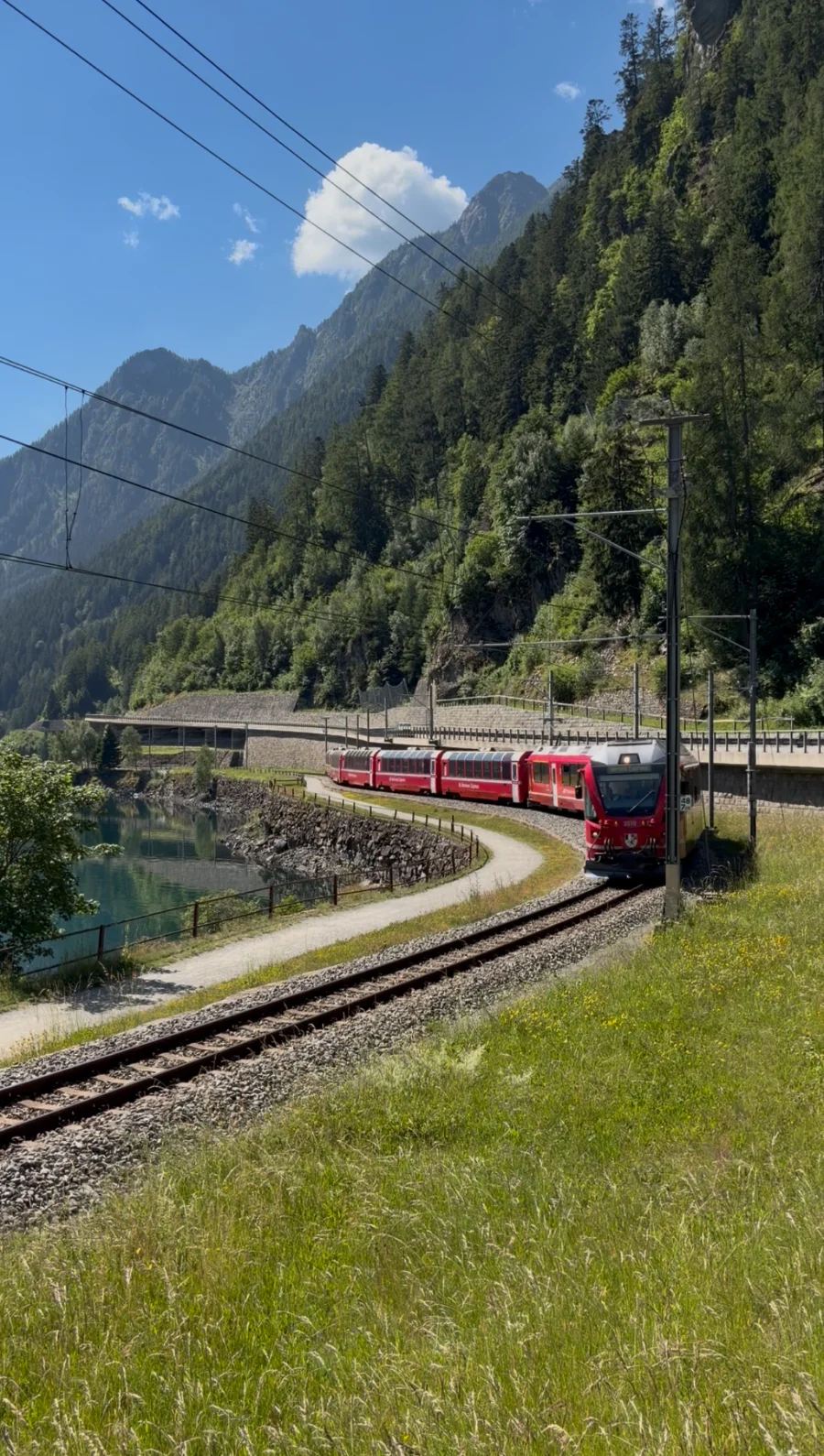
A red Bernina train in summer, on the green lower part of the line. Photo: Oleg Danylyuk.
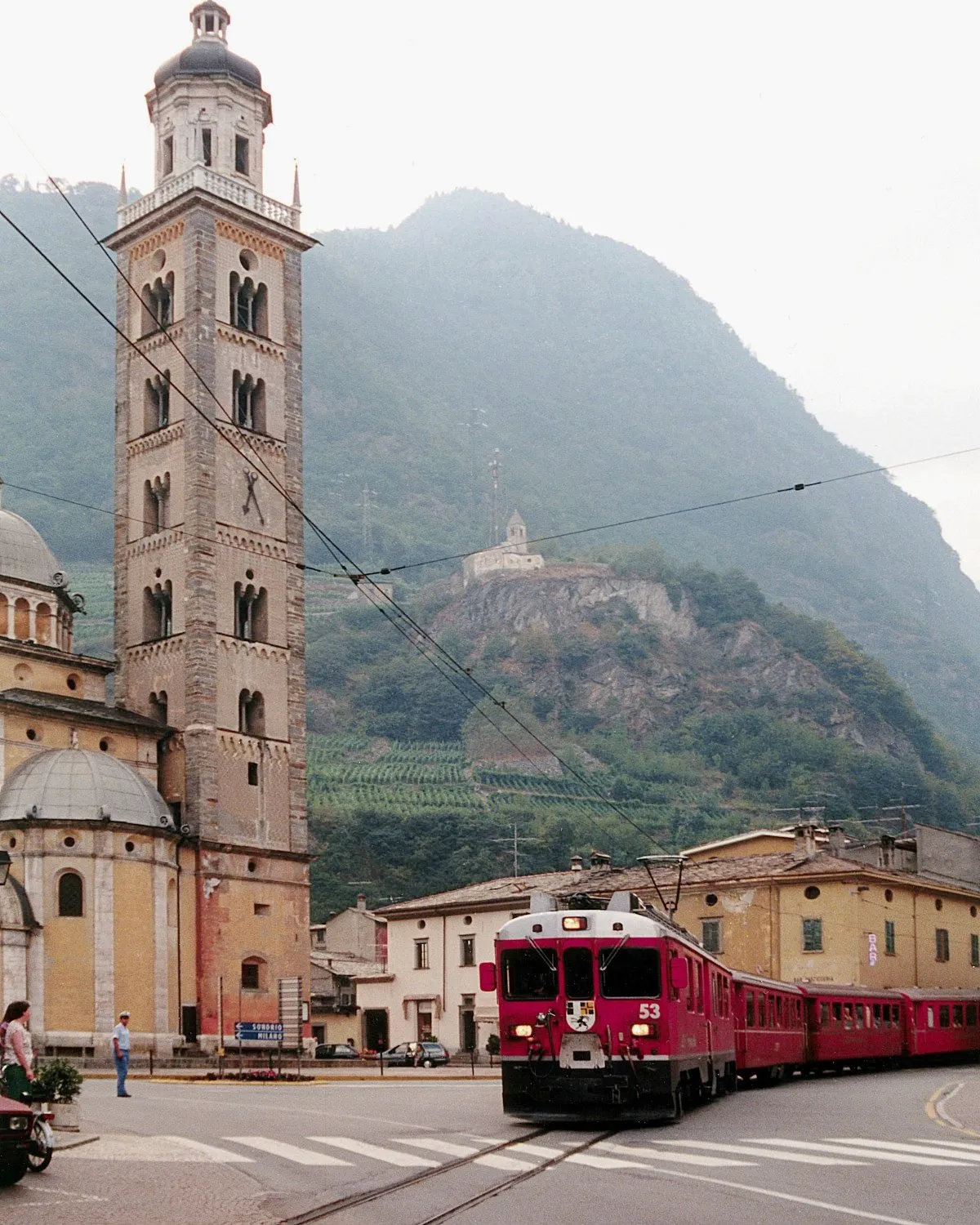
Leaving Tirano past the Madonna di Tirano basilica. Photo: Herbert Ortner, Vienna, Austria, CC BY 3.0, via Wikimedia Commons.
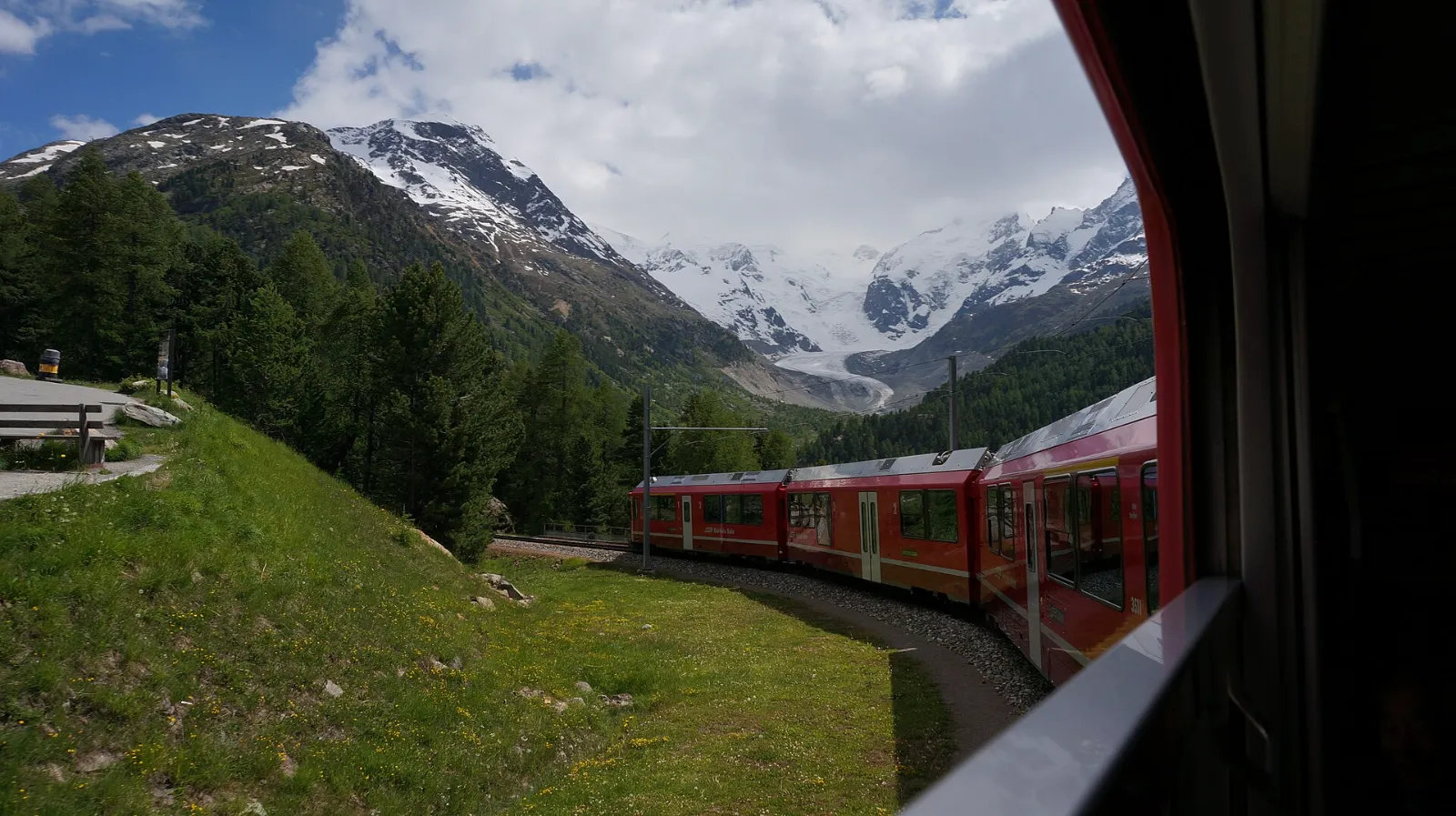
The Morteratsch glacier from the Bernina line. Photo: Ka23 13, CC BY-SA 4.0, via Wikimedia Commons.
The best views change sides several times on the way up, especially through the loops and around the lakes. On the panoramic Bernina Express it matters less, because you also see through the roof. On a regular train, a window seat is what makes the difference.
Coach tour, DIY train or private: what each really costs you
| Option | Typical cost | The day |
| Big coach tour | €89–175 per person (November 2026 sample of Milan departures) | ~13 h, regular train, seats usually not assigned, fixed schedule |
| DIY by train, same day | ~€96 per person, 2nd class return on regular trains (October 2026 example), plus ~CHF 32 per panoramic leg if you choose the Bernina Express | ~10 h sitting on trains, 13–14 h in total |
| DIY with a night in Tirano | Train tickets + one hotel night | Early-morning train, real time in St. Moritz, back in Milan in the evening |
| Private tour (Abroads Tours) | From €1,498 for 2 guests (€749 each), up to €2,299 for 6–7 · €100/guest deposit, free cancellation up to 72 h | ~12 h, hotel pickup, best bernina window seats reserved in advance, your own guide |
Doing it yourself by train saves less than people think. Milan Centrale to Tirano is about 2h30 on the regional train (Trenord), Tirano to St. Moritz another 2h15–2h30 on the RhB, then the same back: about 10 hours on trains, without counting connections. Miss one connection and you can lose an hour or more. Realistically it becomes a 13–14 hour day, and the time in St. Moritz gets very tight. It works, but go in knowing that. Use the Trenord and RhB timetables for your date.
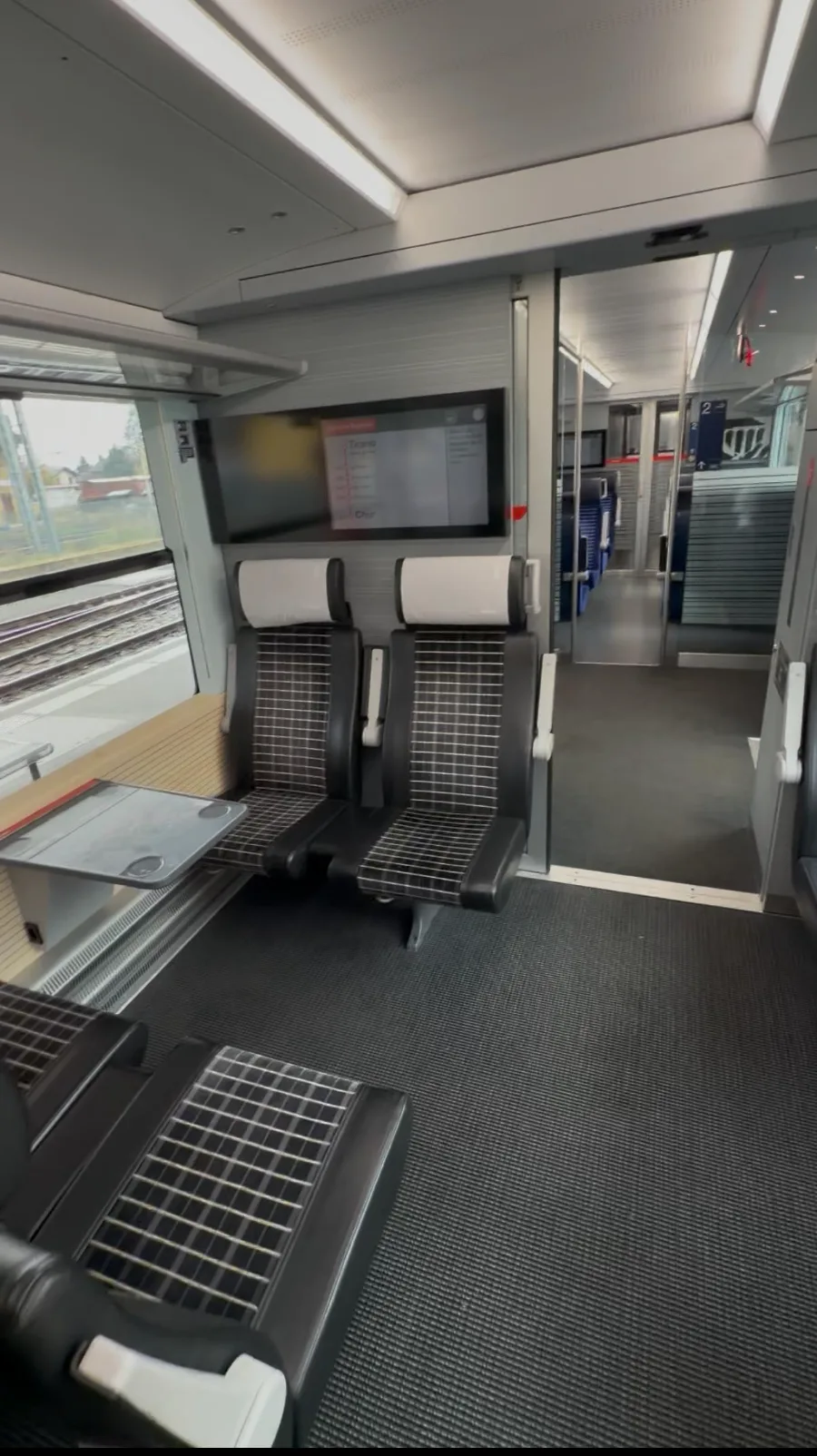
A regular train on the Bernina line: comfortable first class, with the route shown on screen. Photo: Oleg Danylyuk.
The best DIY version: take the train to Tirano the evening before, sleep there, catch an early Bernina train in the morning when carriages are emptiest, have real time in St. Moritz, and be back in Milan in the evening. More relaxed and more flexible.
Is the Bernina Express from Milan worth it? Our verdict by traveller
| If you… | Choose |
| want to see the Alps for relatively little money and organise nothing | A big coach tour, with open eyes about seats and timing |
| want to save a little and keep flexibility | DIY by train, ideally with a night in Tirano |
| want the panoramic carriages themselves | Reserve the Bernina Express months ahead, or ask us to book it |
| want first class, a dedicated guide, flexibility and a proper local lunch | A private day with hotel pickup |
| dislike long days on the road | Stay overnight near the line, or pick a closer day trip like Lake Como |
|
Private Bernina day from Milan · €1,498 for 2 guests Hotel pickup and drop-off in Milan, your own guide, first-class seats at the window booked in advance (on the Bernina Express panoramic cars whenever seats are available; we confirm the exact train), and time for St. Moritz and a local lunch. Confirm with €100 per guest, free cancellation up to 72 hours before, and a free date change in winter (November–March). See the itinerary and check your date · Ask Oleg on WhatsApp |
The no-surprises checklist
- Not on a Sunday, and avoid Italian public holidays if you can.
- Ask which train and which class. Bernina Express or regular train? First or second class? Assigned seats or not?
- Check St. Moritz's weather and season (early November: almost everything closed).
- Dress in layers. About 10°C (18°F) colder than Milan is normal; in winter it can be far below zero.
- Passport or valid EU ID card. You cross into Switzerland; check the entry rules for your nationality. Swiss francs are handy, cards work almost everywhere.
- Book the Bernina Express months ahead if you want it, especially first class and the Christmas period.
- On a big group tour: be first in line at the train, and tip the guide early.
- Decide about lunch before the day. Lunch or sightseeing: there is rarely time for both.
- Bring water and a snack. Coach stops are few, and not every coach has a usable toilet.
Planning other day trips too? Read our best and worst day trips from Milan, the Lake Como day trip guide (same road as the Bernina), or watch the line in our short Bernina Express video.
Once-in-a-lifetime or wasted day? You decide before you book
The Bernina itself never disappoints: a UNESCO railway, a climb from palm trees to glaciers, the Brusio spiral, the white lakes at the pass. What turns it into a bad day is always the same list: too many hours on the road, the wrong carriage, the aisle seat, a Sunday, no time for lunch, a closed St. Moritz.
Know all of this before you choose, and whichever option you pick, you'll come back with the day you expected.
Frequently Asked Questions
Does the Bernina Express leave from Milan?
No. On the day-trip route the Bernina Express runs between Tirano in Italy and St. Moritz in Switzerland. Milan is about 160 km from Tirano by road. From Milan you first travel to Tirano or St. Moritz by road or regional train, then ride the Bernina line.
How long is a Bernina day trip from Milan?
About 12–13 hours for an organised day trip, of which about 5–6½ hours are on the road and about 2¼–2½ hours on the Bernina train between Tirano and St. Moritz. Doing it yourself by train means about 10 hours on trains and 13–14 hours in total.
Do coach tours from Milan use the Bernina Express?
Usually not. Large groups are typically booked into whole carriages of the regular Bernina trains, often the older ones, because only about one Bernina Express departure a day is usable from Milan and its panoramic seats sell out months ahead. Ask your operator which train and class you'll travel in.
What is the difference between the Bernina Express and the regular Bernina train?
Bernina is the name of the railway line. The Bernina Express is a panoramic service with large windows reaching into the roof and a compulsory paid seat reservation (about CHF 32 per person each way in 2026). The regular trains, including the modern Stadler Allegra units, run the same line with the same scenery roughly every hour.
Is the Bernina Express from Milan worth it?
Yes, if the Alpine railway is the main reason for your day and you accept a long day. The scenery is the same on the regular trains; the panoramic cars are worth it if you book them in advance. If you dislike long road days, stay a night in Tirano or choose a closer day trip.
What is the worst day to do the Bernina from Milan?
Sunday. The road runs along Lake Como and carries lake traffic in summer and ski traffic in winter, in the same direction in the morning and back in the evening. It can add up to 3 hours to the day, and the train is more crowded.
Do I get a window seat on a group Bernina tour?
Not guaranteed. In groups of about 50, individual seats are usually not assigned and whoever enters the carriage first takes the windows. Be first in line. On a private tour with Abroads Tours, window seats are booked in advance.
How cold is it in St. Moritz?
St. Moritz is at 1,822 m (5,978 ft) and is usually about 10°C (18°F) colder than Milan. It ranges from about +25°C (77°F) on summer days to −25°C (−13°F) on the coldest winter days. Check the forecast for St. Moritz, not Milan, and dress in layers.
Do I need a passport for the Bernina train?
Yes, bring a passport or a valid EU national ID card. The line crosses from Italy into Switzerland, and you need a document valid for entering Switzerland and returning to Italy. Check the requirements for your nationality.
Is there time for lunch in St. Moritz on a day trip?
Usually there is time for lunch or for seeing St. Moritz properly, not both. If lunch matters to you, plan and book it in advance in St. Moritz or Tirano.
How much does a private Bernina tour from Milan cost?
With Abroads Tours the private Bernina day costs €1,498 for 2 guests (€749 each), €1,699 for 3, €1,899 for 4, €2,099 for 5 and €2,299 for 6–7, with hotel pickup in Milan, first-class window seats booked in advance and your own guide. Larger groups on request. Book with a €100 per guest deposit; the rest is charged 72 hours before the tour. Free cancellation up to 72 hours before (deposit included), and from November to March one free date change.
About the author. Oleg Danylyuk is a licensed tour guide in Milan and co-founder of Abroads Tours S.R.L., a licensed Italian tour operator rated 5.0 from 3,500+ reviews on Google, TripAdvisor and GetYourGuide (company-wide). He has guided hundreds of Bernina days from Milan, in every season and every format.
Photos: credited under each image. Train and landscape photos from Wikimedia Commons; photos marked "Oleg" are my own; images marked "Illustration" are AI-generated to show typical situations.